// Date added to the website; the source PDF does not specify a publication date.
Panopticon of spectators
By Mayank Prasoon Tirkey
Foucault, in his book Discipline and Punishment (1975), talks about an architectural structure called the Panopticon, a term originally coined by Bentham (1791). A composition of a Panopticon is built with two basic elements-
- An angular building in the periphery
- A central observation tower
The angular building on the periphery is made up of multiple cells. Each cell has two windows, one for the light and another for surveillance. Through the central tower, an Observer can see everything that is happening inside the cell. (Foucault 1975, p. 200). The architecture of the Panopticon makes it possible for the Observer in the central tower to keep an eye on the cell. Here, the wall of the cell acts as a separation making sure the Observed also doesn’t know if others are also being observed at the same time. In the words of Foucault (1975) -
He is seen, but he does not see; he is the object of information, never a subject in communication. The arrangement of his room, opposite the central tower, imposes on him an axial visibility; but the divisions of the ring, those separated cells, imply a lateral invisibility. (p. 200)
Due to the nature of the Panopticon. A lingering paranoia remains in the mind of the Observed. The central tower becomes a tool that exerts power on the Observed.
Foucault expanded this idea from a physical architectural structure to an abstract conceptual mechanism where panopticism results in a certain kind of automatized discipline. Even if the actual act of surveillance is not taking place.
Sports and Discipline
This mechanism of observation extends beyond prisons into everyday life, too. I, most likely, like other men of my age, wanted to explore myself and my limits by engaging in calisthenics. Unlike Gyms, calisthenics is a form of physical exercise that utilizes an individual's own body weight without the help of any machine or equipment. And also, unlike Gym, calisthenics is something that can be done in the open air. Where people can see what an individual is doing.
In any form of physical exercise, the role of an instructor or guide is very important. Without it, the routine can result in an injury. The instructor constantly observes to make sure the routine is done correctly with the right posture and the right amount of time to maximize improvements. In a way, we can say that the instructor wants to follow a certain kind of discipline
Since the nature of this Calisthenics was usually open. There were people other than the trainer and the trainee — The spectators. The role of the spectators is something that is the most interesting of all. A spectator can be someone who is part of the routine, a spotter, a passerby, or even an old lady looking from the balcony. The spectators don't need to be a part of the immediate space of the person doing the exercise. But rather someone that the person acknowledges.
The rule of the spectators and the trainer feels very much like an Observer. Here, the Observer exercises his power to make sure a certain discipline is followed. The cheering or wincing of the spectators acts as a reward mechanism for the Observed; A simple tap on the shoulder from the trainer becomes the motivation for the Observed.
We all take turns to become the Observer and the Observed while doing the routine. Even when someone is not looking directly at the individual, the mere presence of an spectators-like figure can result in the individual acting in accordance with the discipline.
If we look at this through the lens of Foucault, the trainer, the timer, and the instruction become the cell of this Panopticon that makes sure a certain discipline is followed. In contrast, the spectators become the tower whose mere presence ensures the specified discipline is followed.
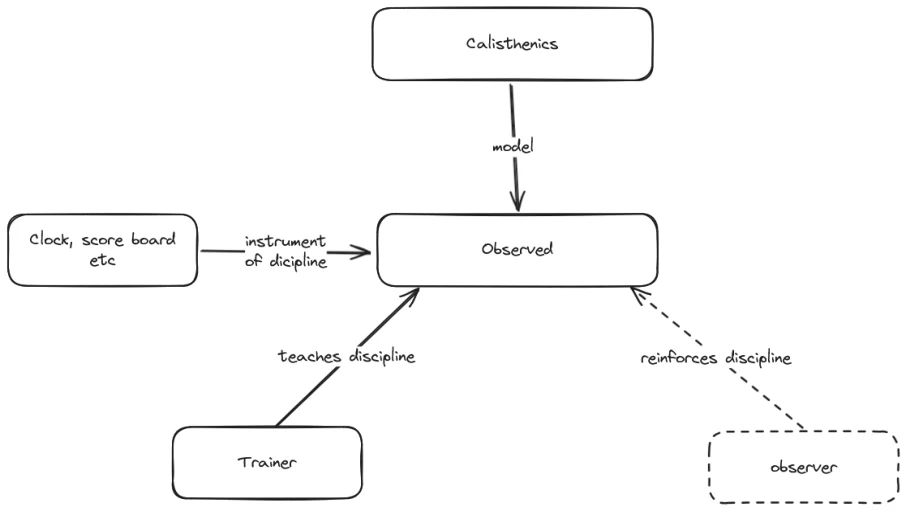
The role of spectators is crucial in the field of sports. An spectators has a very deep impact on the Player and their performance. In the Tokyo Olympics 2020, which got rescheduled to 2021 due to the COVID-19 Pandemic. The event largely took place without any public spectators. According to an article on Time by Alice Park (2021)
consciously or unconsciously, athletes take their cues from vocal spectators—encouraged by claps and cheers, and even motivated by boos. “Crowd noise and excitement are something that increase athletes’ adrenaline even further,” says James Houle, lead sports psychologist for Ohio State Athletics. “Without a crowd, athletes will really have to find that energy within themselves or from their teammates. They will have to rely on each other more than ever to help with that energy.
The presence and absence of an Observer does impact the Observed. The pressure to avoid making a mistake is immense. The internalization of the presence of the observer is where panopticism emerges.
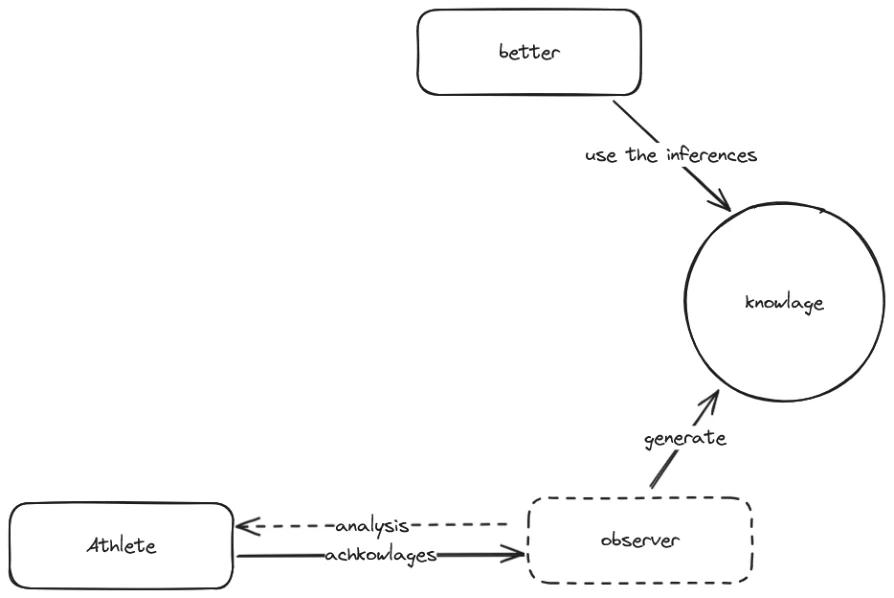
The spectators not only affects the athlete and enforces discipline, but also generates knowledge in a self-regulatory manner. When a trainer watches an athlete fail to do his routine. It becomes a learning lesson for the athlete and the spectators.
Knowledge Created by the Athlete
The spectators themselves create knowledge that goes beyond the sports itself, a realm where the agency of the athlete gets dissolved into pure number and chance.
Betting as an activity has always fascinated me. Even though I have never participated due to its negative cultural perception. I have lived very close to people who have been an active gambler. The act of betting requires a deep knowledge of the athlete whereas the role the athlete plays becomes negligible, if we ignore match fixing.
Similar to a good coach, a bettor needs to know everything about the athlete, their past performance, and the team’s performance. His or her health condition and past injuries, and the condition of the ground. In all of this, the athlete is completely unaware of the act of betting. He she doesn’t have any direct role in the flow of the betting process. We can say that the athlete loses their agency. In betting, the athlete becomes what the statistics describe him or her as.
The act of Surveillance, as mentioned by Foucault, “The Panopticon functions as a kind of laboratory of power. Thanks to its mechanisms of observation, it gains in efficiency and in the ability to penetrate into men's behaviour; knowledge follows the advances of power, discovering new objects of knowledge over all the surfaces on which power is exercised.” (1975, p. 204) turns the life of an athlete into an observation center where the goal becomes to observe and document as many details as possible. It creates knowledge through the analysis of these athletes. By deeply analyzing the people on the field.
The horrifying depth of this trench of knowledge and its application goes beyond the athlete, the scoring system, the timer, the match fixture, and the order of the match; all of these get engulfed in this trench and become part of the mechanism.
Conclusion
In sports and fitness we can observe what Foucault calls Panopticon. Where the athletes get documented and analysed and where the data goes beyond the sports and out of the control of the athlete.
The very presence of the spectators reinforces discipline and creates knowledge that goes beyond the athlete and sports, rendering him docile.
Reference
Bentham, J. (1791). Panopticon; or, The inspection-house. Dublin: Thomas Byrne.
Foucault, M. (1975). Discipline and punish: The birth of the prison (A. Sheridan, Trans.). New York: Vintage Books. (Original work published 1975)
Park, A. (2021, July 25). How will empty stands affect Olympic athletes in Tokyo? Time. Retrieved (2025, August 25), from https://time.com/6083142/no-spectators-olympics-impact-athletes/